



Skip to content
Garment Export House

Garment Export House

Learn with us

  • Textile
  • Quality Control
  • Production Management
  • Toggle search form
  • Machine SPI in Garment Stitching Uncategorized
  • Mimaki To Bring New Innovations And Application Opportunities To FESPA 2021 Uncategorized
  • Does branded clothing companies use new fabrics? Uncategorized
  • Top Garment Export Houses in Tirupur, Tamil Nadu, India Uncategorized
  • Garment Export House Departments and Their Functions Uncategorized
  • Online Calculators for Garment Industry Professonals Uncategorized
  • Reliance Launches R.Elan, a Fashion Line Made of 100% PET Bottles Uncategorized
  • Guess Partners With QIMA To Digitize Quality Control Program Uncategorized

Full Form of KPD in Fashion Industry

Posted on July 4, 2024August 14, 2026 By Admin No Comments on Full Form of KPD in Fashion Industry

Full form of KPD is Knitting Process Division.

In the apparel supply chain, companies that have business in other verticals they categorize their business es in different divisions. Like textile division, garment division, knitting division, etc.

Similarly, a garment export house that has knitting processing division, they call it KPD in short. The knitting processing involved in dyeing and wet processing of knitted fabrics.
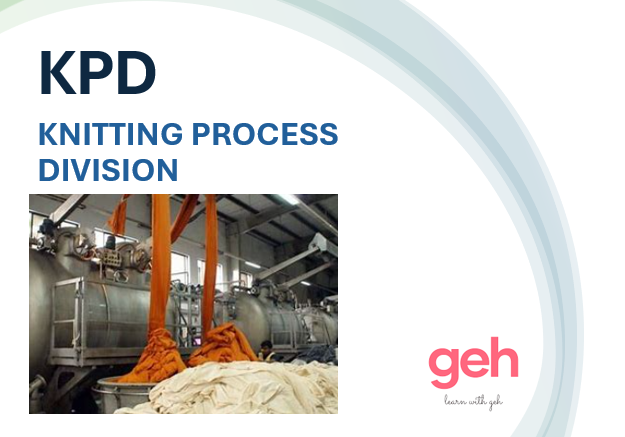
Full form of KPD
Knitting process deivision


Key functions of knitting Division:

After knowing he full form of KPD, let’s leran the key functions of this division.
The knitting division in a textile mill is responsible for transforming raw yarn into high-quality greige (unrefined) fabric. Its core operational objectives are maximizing machine efficiency, reducing defects, and ensuring the fabric meets strict structural specifications.

1. Production Planning and Yarn Management

  • Yarn Sourcing and Inspection: Receives yarn packages from spinning mills and checks them for proper count, twist, and strength.
  • Creeling and Setup: Organizes yarn cones systematically on creels based on the specific fabric design and structure needed.
  • Inventory Control: Matches incoming yarn lots with specific production orders to prevent color variations (shading differences) later in the dyeing phase.

2. Machine Operations and Settings Control

  • Stitch Length Calibration: Sets exact yarn feed lengths per needle loop to control the final weight (GSM) and density of the fabric.
  • Tension Balancing: Adjusts electronic tension discs to ensure uniform yarn flow and avoid fabric skewing or spirality.
  • Pattern Programming: Configures mechanical cams or uploads digital CAD files to computerised knitting machines to create patterns like rib, interlock, or jacquard. 

3. Quality Assurance and In-Line Inspection

  • Grey Fabric Inspection: Reviews every freshly knitted roll over an illuminated glass table to catch faults immediately.
  • Defect Mapping: Identifies and logs mechanical errors like dropped stitches, oil spots, thick/thin places, or needle lines.
  • Real-time Troubleshooting: Monitors electronic stop-motions to instantly halt machines when a yarn breaks, reducing fabric waste.

4. Post-Knitting Operations and Maintenance

  • Doffing and Batching: Cuts, removes, and weighs completed fabric rolls from the machine at designated yardage targets.
  • Machine Maintenance: Executes routine cleaning to remove accumulated lint and performs precision needle and sinker replacements.


Read the related Full Forms:

Question: What is the Full Form of SAM?

Answer: SAM stands for Standard Allowed Minutes. This represents the minutes required to complete an operation.

Question: What is the full form for SMV?

Answer: SMV stands for Standard Minute Value. Learn more about SMV.

Question: What is BOM?

Answer: BOM stands for Bill of Materials. Learn more about BOM.

Question: What is OB?

Answer: In the aspect of industrial Engineering in the garment manufacturing, OB stands for operation bulletin.

Author

  • Admin
    Admin

    Admin user

Textile Tags:Full Form, Knitting

Post navigation

Previous Post: Popular Countries to Source Apparel and Textile Products From
Next Post: PP Meeting in Garment Manufacturing – All That You Need Know

Related Posts

  • Abrasion and Pilling Testing for Textile Materials | Martindale Abrasion and Pilling Tester Textile
  • What is CIF in the Apparel Industry? Textile

Leave a Reply Cancel reply

Your email address will not be published. Required fields are marked *

Latest Posts

  • 20 Types of Fashion Accessories: A Complete Guide
  • Top Garment Buyers in Bangladesh
  • Top 20 Garment Export Houses in India
  • Quality Control vs. Quality Assurance in the Garment Supply Chain
  • How a Custom Clothing Manufacturer Brings Your Designs to Life

  • How to remove polyester yarn contamination from fabrics? Uncategorized
  • Top Garment Export Houses in Delhi NCR, India Uncategorized
  • Full Form of GSP in Garment Export Business Uncategorized
  • T-shirt Printing Process for Bulk Production (Steps to Follow for Garment Export Orders) Uncategorized
  • Abrasion and Pilling Testing for Textile Materials | Martindale Abrasion and Pilling Tester Textile
  • i-Smart sewing operator rating system by NIFT innovative team Uncategorized
  • What is UBT in Sewing Machine Categories for Garment Manufacturing Uncategorized
  • Straight knife fabric cutting machines – all that you need to know Uncategorized
  • Directory

Disclaimer

Copyright © 2026 ocs.hostingersite.com.

Powered by PressBook News WordPress theme