
Skip to content
Garment Export House

Garment Export House

Learn with us

  • Textile
  • Quality Control
  • Production Management
  • Toggle search form
  • Top Garment Export Houses in Chennai, India Uncategorized
  • Popular Countries to Source Apparel and Textile Products From Directory
  • What are the job roles of a merchandise planner in garment retailing? Uncategorized
  • What is the Difference Between Thread and Yarn? Uncategorized
  • MOQ Full Form Uncategorized
  • Functions of the Finishing Department in a Garment Factory Uncategorized
  • What is AQL in Garment Industry? Quality Control
  • Functions of the Cutting Department in a Garment Industry Uncategorized

What is Bow and Skew in Fabric?

Posted on October 13, 2021July 10, 2026 By Admin No Comments on What is Bow and Skew in Fabric?

Bowing and skewing in finished fabric are among the common problems found in woven fabrics. 

In the finished fabric, distortion of warp and weft yarns alignment happened due to improper tension application on fabric across the width in weaving and finishing process. As a result, Bow or Skew occurred in woven fabrics. In this page, we have explained the bow and skew formation with images.

What is Bow in Fabric?

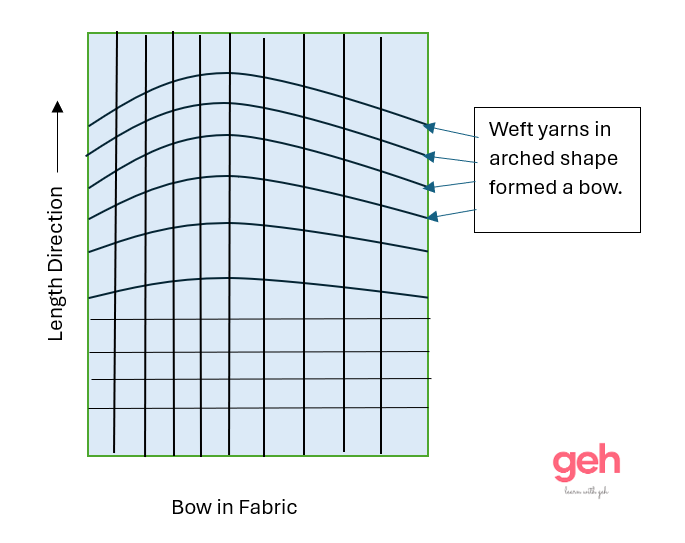
When weft yarns are even at two edges but arched across the middle is known as Bow. 
As per apparelscience.com bowing problem mainly occurs due to faults in weaver’s beam. This kind of situation can reflect in the beams to be manufactured on the sectional warping machine as well as the direct warping machine.
Bow in fabric

What is Skew in Fabric?  

When weft yarns are straight from one end to another end but angled across the width of the fabric is called skew in fabric. Refer to the below diagram for skew formation in woven fabric due to angled weft yarns. 
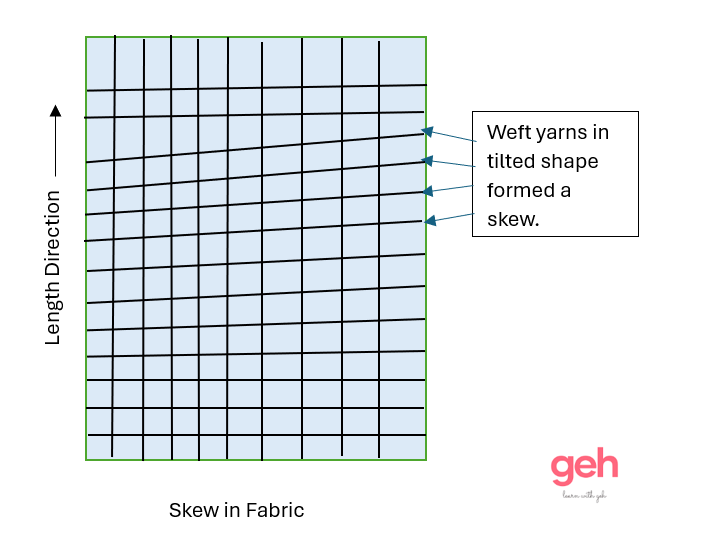
Skew in fabric

While fabric is used in garment making with these problems, you will get defective garment, like twisted effect will be found in the side seam of the tops.

Further reading: The causes of bows and skews in fabrics. 

Author

  • Admin
    Admin

    Admin user

Uncategorized Tags:Fabrics, Quality Control, Terms and Definitions

Post navigation

Previous Post: 18 Different Types Sewing Machines Used by Garment Export Houses
Next Post: Full form of FOB in garment sourcing

Related Posts

  • Pantone Color Of The Year 2022 – PANTONE® 17-3938 Very Peri Uncategorized
  • Top Countries Exported Apparels to U.S. (By Quantity) in Year 2023 Uncategorized
  • 18 Different Types Sewing Machines Used by Garment Export Houses Uncategorized
  • Double Cloth and It Construction Method Uncategorized
  • Snapshot of the Indian Textile and Garment Industry Uncategorized
  • What is An Export House? Uncategorized

Leave a Reply Cancel reply

Your email address will not be published. Required fields are marked *

Latest Posts

  • 20 Types of Fashion Accessories: A Complete Guide
  • Top Garment Buyers in Bangladesh
  • Top 20 Garment Export Houses in India
  • Quality Control vs. Quality Assurance in the Garment Supply Chain
  • How a Custom Clothing Manufacturer Brings Your Designs to Life

  • Fabric and Garment Testing Labs in India and Bangladesh Uncategorized
  • Pantone’s Fashion Colour Trend Report for Spring/Summer 2022 Uncategorized
  • What is the Difference Between Thread and Yarn? Uncategorized
  • T-shirt Printing Process for Bulk Production (Steps to Follow for Garment Export Orders) Uncategorized
  • Functions of the Sewing Department in a Garment Factory Industrial Engineering
  • Garment Export House Departments and Their Functions Uncategorized
  • Various Light Sources Used for Lab Dip Color Matching (in Color Cabinet) Uncategorized
  • T&A Calendar for Apparel Merchandisers Uncategorized
  • Directory

Disclaimer

Copyright © 2026 ocs.hostingersite.com.

Powered by PressBook News WordPress theme